Today I want to write about amputee devotees and people who experience Body Integrity Dysphoria (BID), sometimes referred to as BIID—Body Integrity Identity Disorder.
In 2017, about nine months after my amputation, I decided to create a YouTube channel connected to my Instagram account. I hadn’t been very active on Instagram—my last real post before that had been in 2014—but a few months after my amputation in 2016, I began posting again. By 2017, I launched a yoga-focused YouTube channel centered on being an amputee practicing yoga.
I started uploading videos of myself doing asana with one leg, without a prosthetic, and with my prosthetic. To my surprise, these videos gained thousands of views. My Instagram following grew, and I began receiving emails through my YouTube channel.
That’s when I encountered something completely new to me: “devotees.”
Until then, the only context in which I was familiar with the word “devotee” was religious, specifically in Hinduism. I had no idea the term was also used to describe people who are sexually attracted to amputees and people with debilitating physical disabilities. Very quickly, I was introduced to the world of amputee devotees through unsolicited emails offering significant amounts of money for custom videos meant to satisfy their fetish.
At first, I was shocked. Then briefly conflicted. Then angry.
Some of the requests were deeply unsettling and completely at odds with why I had created my platform in the first place. I wasn’t there to be sexualized. I was there to share movement, healing, and life after limb loss.
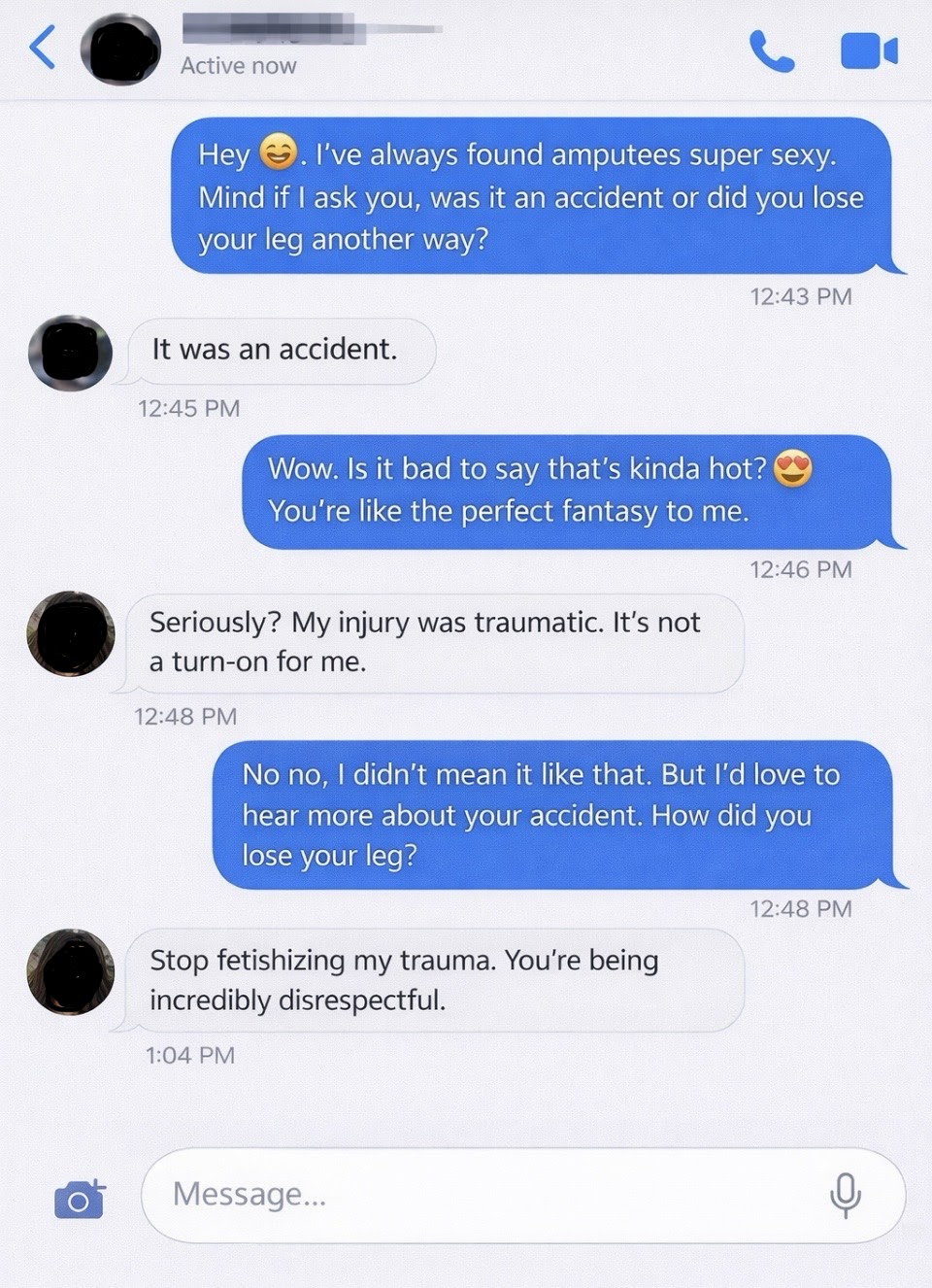
Soon after, devotees began appearing in my Instagram messages as well. At the time, my profile was public, and I believed I was connecting with fellow amputees or people seeking inspiration. Instead, I learned that a devotee is someone with a sexual attraction to amputees—a form of attraction often referred to as acrotomophilia.
As I dug deeper, I learned there are entire fetish subcultures centered on limb difference, often framed as “artistic” or “erotic.” These portrayals overwhelmingly focus on women. While I’m sure male amputees are fetishized as well, the imbalance is noticeable.
Around the same time, another group began reaching out to me: people with Body Integrity Dysphoria.
I didn’t know the term then, but I later learned that BID is recognized in the International Classification of Diseases (ICD), though it is not listed as a diagnosis in the DSM-5-TR (the diagnostic and statistical manual of mental health disorders). One reason for this is the profound ethical dilemma it presents—particularly around whether elective amputations should ever be considered as treatment.
BID involves a distressing mismatch between a person’s mental image of their body and their physical body. Someone with BID may have healthy limbs but feel that they are “not supposed to be there,” and may believe they would feel complete only as an amputee.
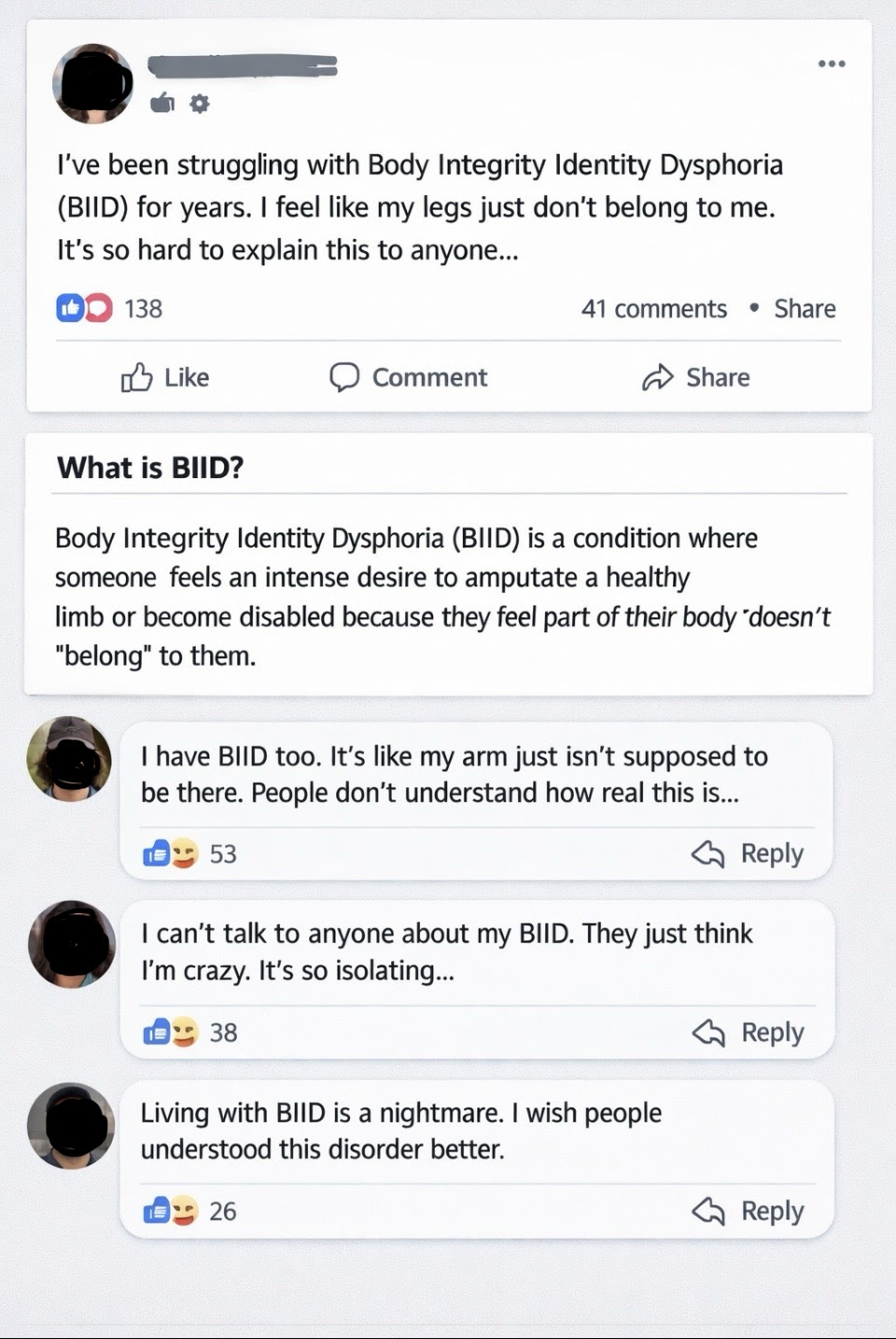
As someone who lives with CPTSD, anxiety, depression, and OCD, I have deep empathy for people who suffer from mental illness, even though BID is not officially considered a mental illness; to me, it most certainly is. I believe BID is real, rare, and profoundly distressing. There is limited research, unclear causes, and ongoing exploration of possible neurological links. I have compassion for anyone living with that kind of internal suffering.
That said, my compassion has limits—especially when people with BID reach out to me on social media without disclosure or consent.
Many of these messages came from men overseas who asked how I lost my leg and then went on to describe, in detail, their desire to amputate their own healthy limbs. Some described plans to intentionally injure themselves to force medical amputation.
I was horrified.
I didn’t ask to be involved in anyone else’s dysphoria or fetish. Being confronted with these messages—unsolicited—was deeply upsetting. I didn’t want to know these details, and I certainly didn’t want to be positioned as part of someone else’s fantasy or psychological distress.
At the time, social media communities often referred to people with BID as “wannabees,” a term I found troubling but also reflective of how invasive and relentless the messaging became. The longer I stayed visible online, the more I was bombarded.
Here’s where I draw a firm line.
I can hold compassion for mental illness while also saying this: it is not appropriate to contact amputees—many of whom lost limbs through trauma—and ask them to relive that trauma for your curiosity, dysphoria, or sexual interest. It is not acceptable to frame limb loss as something enviable or celebratory to people who never wanted to lose their limbs.
I also don’t believe in kink-shaming. Attraction is complex, and people are allowed to have preferences. But there is a difference between private attraction and actively fetishizing a marginalized group—especially when that fetish is imposed directly and without consent on the very people it objectifies.
When a disability becomes the sole focus of sexual interest, when boundaries are ignored, and when amputees are reduced to objects rather than people, it crosses a line.
Do what you do. Live your life. Seek help.
But do not involve unwilling participants—especially those whose bodies and lives have already been shaped by loss, trauma, and survival.
Some things do not need to be shared. And they certainly do not need to be shared with the object of someone else’s fetish or dysphoria.
This is the reason I deleted my YouTube channel. I also took a six-year break from Instagram, and I’ve just recently returned. I have weeded through my followers and deleted those who were not respectful of my boundaries.
Please like, comment, share, and subscribe to my blog. Thank you for being here.
6 responses to “Devotees and BID and Social Media, Oh my!”
-
thank you for sharing this. I am also in the reddit amputee group and lost my legs, one at a time, due to crps and mrsa. I am a middle-aged man but get contacted every once in a while by devotees. they are easy to spot quickly, at least as they approach me. i’m not as visible right now online, so they ask bizarre questions. I thought it was somewhat harmless at first, too, but found them to be obnoxious very quickly. I imagine it is far worse for women and some young men, who are the main focus (women more so). I don’t know what to say about BIID. life as an amputee is not fun, especially when you can barely use your legs like me, and they are in constant pain. people with BIID also made it very difficult, indirectly, for me to get my first leg off, when it was destroyed by crps, but I kept getting questions about why I wanted it off. not a fetish, it was nonfunctional and exceedingly painful. thank you for writing. it is a joy to read.
-
Thank you for your comment, support and for sharing your experience.
LikeLike
-
-
Hi Jenna, thank you so much for this post. I want to say that I agree with it almost 100%, but I would argue that being a “devotee“ of amputees does not mean that the attraction is purely sexual. Ashamedly, I have been a “devotee” for a very long time, and I have struggled with it my whole life. I don’t understand it, and I have been to numerous counseling sessions, trying to understand and read myself out of it, but it stays with me. The biggest question I run through my mind is “how dare I find something attractive that has been such a traumatic incident for someone else?
Many are similar to me, who do not care about the trauma losing a limb may have caused a person, and they go full-bore into satisfying their sexual urges. But I want to let you know that many, many admirers are not like that—those who are very respectful of women and do not solicit them for personal gain.
As a heterosexual man, I am also attracted to many other things about women. I love blonde hair and blue eyes, and I also think the glow of a pregnant woman is one of the most beautiful things in the world, but similar to my attraction to amputees, I don’t just walk up to somebody I don’t know and ask to stroke their hair or touch their belly when they are pregnant. There’s a boundary of respect and compassion that needs to be observed at all times, and unfortunately, it is not always observed.
Usually, something initially attracts a person to the other person. Something that fancies their interest or gets their attention quickly, and for many men, a person who is significantly different limb-wise is one of them. That is not an excuse for a person to feel like they are entitled and start sexualizing those objects.
I’m so sorry that you have had to go through this.
LikeLike
-
I sure hope that was a typo; “Many are similar to me, who do not care about the trauma losing a limb may have caused a person”. I think and hope you meant, The trauma isn’t what attracts you. I don’t think sexual attraction has to be sexual arousal, but the general definition of acrotomophilia is a sexual attraction; sexual attraction is a desire for sex driven by a combination of biological and psychological factors. It often manifests as physical arousal, lust, fantasies, and urges. As you described finding blonde, blue eyes and pregnant women attractive. I want to understand why you used the word “ashamedly”, why are you ashamed if your attraction isn’t sexual in nature? Truly curious. This is a safe place. Thank you for your comment and being vulnerable.
LikeLike
-
I should always proofread better! I meant to say “many who are similar to me do not care about the trauma…”
As far as the reference to shame, I was trying to convey that I am ashamed that my attractions cause others, such as yourself, to feel hurt or victimized or any other way than what you are comfortable with. Whether it’s sexual or not, I get upset that my attractions, desires, etc., would ever cause another human being distress or discomfort. And finally, yes, there IS a sexual component to the attraction, but there are many other components, and sexuality is not always the primary one.
Thank you for taking the time to respond to me and read what I said! Sorry for the typo!
-
I don’t think it was a proofreading issue. I think I know what you mean, but it reads as if you and other devotees don’t care about someone’s trauma in general. As if you and others have zero empathy for someone who has suffered trauma. But what I think you mean to say, is that you and other devotees are not attracted to the amputee’s trauma. When I proofread my writing, I like to read it aloud, to see what it sounds like. I may know what I mean, but does the person reading know what I mean? Either way, I am glad you’re here, reading my work and contributing from your perspective. Thank you.
-
-

 Living Alone With Limb Loss
Show some LOVE